In July, domestic tin ore imports continued to rise, with imports from the Democratic Republic of the Congo and Australia reaching historical highs [SMM Analysis].

Published: Aug 20, 2024 18:28
Source: SMM
In July, domestic tin ore imports were 15,000 mt (metal content approximately 6,429 mt), up 17.56% MoM, down 51.20% YoY, and increased by 1,270 mt compared to June. The cumulative imports from January to July were 106,000 mt, down 26.23% YoY. In July, domestic tin ingot imports were 840 mt, up 344.44% MoM, down 61.34% YoY. The cumulative imports from January to July were 8,481 mt, down 49.49% YoY.

In July, domestic tin ore imports were 15,000 mt (metal content approximately 6,429 mt), up 17.56% MoM, down 51.20% YoY, and increased by 1,270 mt compared to June. The cumulative imports from January to July were 106,000 mt, down 26.23% YoY. In July, domestic tin ingot imports were 840 mt, up 344.44% MoM, down 61.34% YoY. The cumulative imports from January to July were 8,481 mt, down 49.49% YoY.

In July, domestic tin ore imports showed an upward trend, mainly due to increased imports from Myanmar and the Democratic Republic of Congo (DRC), while imports from other countries remained stable. Specifically, tin ore imports from Myanmar in July were 6,800 mt (metal content approximately 2,025 mt), showing an increase compared to June 2024. Although the authorities in Wa State, Myanmar, have not provided a clear timeline for the resumption of tin ore production, market analysis and forecasts suggest that Myanmar's tin ore imports will remain relatively low in Q3. Meanwhile, tin ore imports from the DRC and Australia are also on the rise. Since the suspension of production in Myanmar, the share of tin ore imports from Africa and other regions in the total domestic imports has continued to increase, and this trend is expected to persist, stabilizing at a high level for some time. Historical data analysis shows that tin ore imports from the DRC and Australia have reached historical highs, partially alleviating the market supply gap caused by Myanmar's mining ban.

On the other hand, with the intermittent opening of the tin ingot import profit window, domestic tin ingot imports have started to show an upward trend. According to the latest data, tin ingot imports in July increased to 840 mt, with imports from Indonesia reaching 727 mt. Considering the recent brief reopening of the tin ingot import profit window and factors such as shipping schedules, some imported tin ingots are expected to arrive in the domestic market in August. However, due to the limited and unstable opening time of the import profit window, tin ingot imports are unlikely to recover to the levels of the same period last year.

Additionally, domestic tin ingot exports in July also showed an upward trend, with specific data at 1,738 mt, up 25.67% MoM and 72.42% YoY. The cumulative exports from January to July 2024 reached 11,425 mt, up 30.44% YoY. However, considering the recent closure of the export window, tin ingot exports are expected to decline in the future.
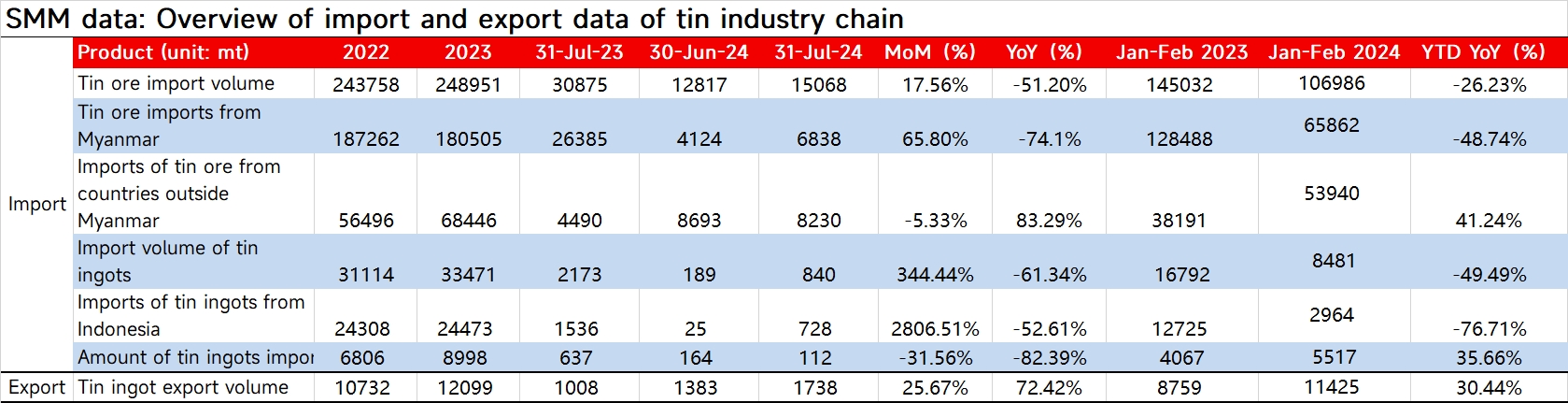

Data Source Statement: Except for publicly available information, all other data are processed by SMM based on publicly available information, market communication, and relying on SMM‘s internal database model. They are for reference only and do not constitute decision-making recommendations.

For any inquiries or to learn more information, please contact: lemonzhao@smm.cn
For more information on how to access our research reports, please contact:service.en@smm.cn
Related News
Data: SHFE, DCE market movement (May 29)
May 29, 2026 15:53
Data: SHFE, DCE market movement (May 29)
Read More
Data: SHFE, DCE market movement (May 29)
The following table shows the ferrous and nonferrous metals movement on the SHFE and DCE on 29 May , 2026
May 29, 2026 15:53
US April Core PCE Price Index Annual Rate Rose to 3.3%, Futures in the Doldrums on the Morning of the 28th [SMM Tin Midday Review]
May 29, 2026 12:07
US April Core PCE Price Index Annual Rate Rose to 3.3%, Futures in the Doldrums on the Morning of the 28th [SMM Tin Midday Review]
Read More
US April Core PCE Price Index Annual Rate Rose to 3.3%, Futures in the Doldrums on the Morning of the 28th [SMM Tin Midday Review]
[SMM Tin Midday Review: US April Core PCE Price Index Rose to 3.3% Year-over-Year, Futures in the Doldrums on the Morning of the 28th]
May 29, 2026 12:07
[SMM Tin News Flash: Multiple A-share Companies Lay Out Solid-State Transformer Sector]
May 29, 2026 08:55
[SMM Tin News Flash: Multiple A-share Companies Lay Out Solid-State Transformer Sector]
Read More
[SMM Tin News Flash: Multiple A-share Companies Lay Out Solid-State Transformer Sector]
[SMM Tin News Flash: Multiple A-share Companies Lay Out Solid-State Transformer Sector]
Catalyzed by the demand for AI computing power and electricity, SST (Solid-State Transformer) technology is quietly emerging as a new trend in the power equipment sector. Reporters noted that recently, multiple publicly listed firms have announced their entry into the SST arena. As a medium- and high-voltage directly connected power electronic device, SST differs from the electromagnetic induction path of traditional power-frequency transformers based on "iron cores + windings." Instead, it utilizes power semiconductor devices to directly build a high-frequency "power direct bridge" between the medium-voltage side and the DC low-voltage side. This architecture eliminates bulky power-frequency transformers, multi-stage rectifiers, and filtering devices, condensing complex power transformation processes into a compact form. Since the beginning of this year, the sustained boom in artificial intelligence data centers (AIDC) has thrust SST, a highly integrated power electronic solution, into the spotlight.
May 29, 2026 08:55